Intro
Last year, I landed several interviews and at least two offers (so far) at some of the top companies in my industry after years of sort of being stuck and not even getting to the interview stage.
In today's article, I want to briefly summarize what I think helped me break through along with useful frameworks which I think anyone can apply when similarly trying to land their dream job or internship.
The frameworks will translate to finding your next opportunity and also to your career in general.
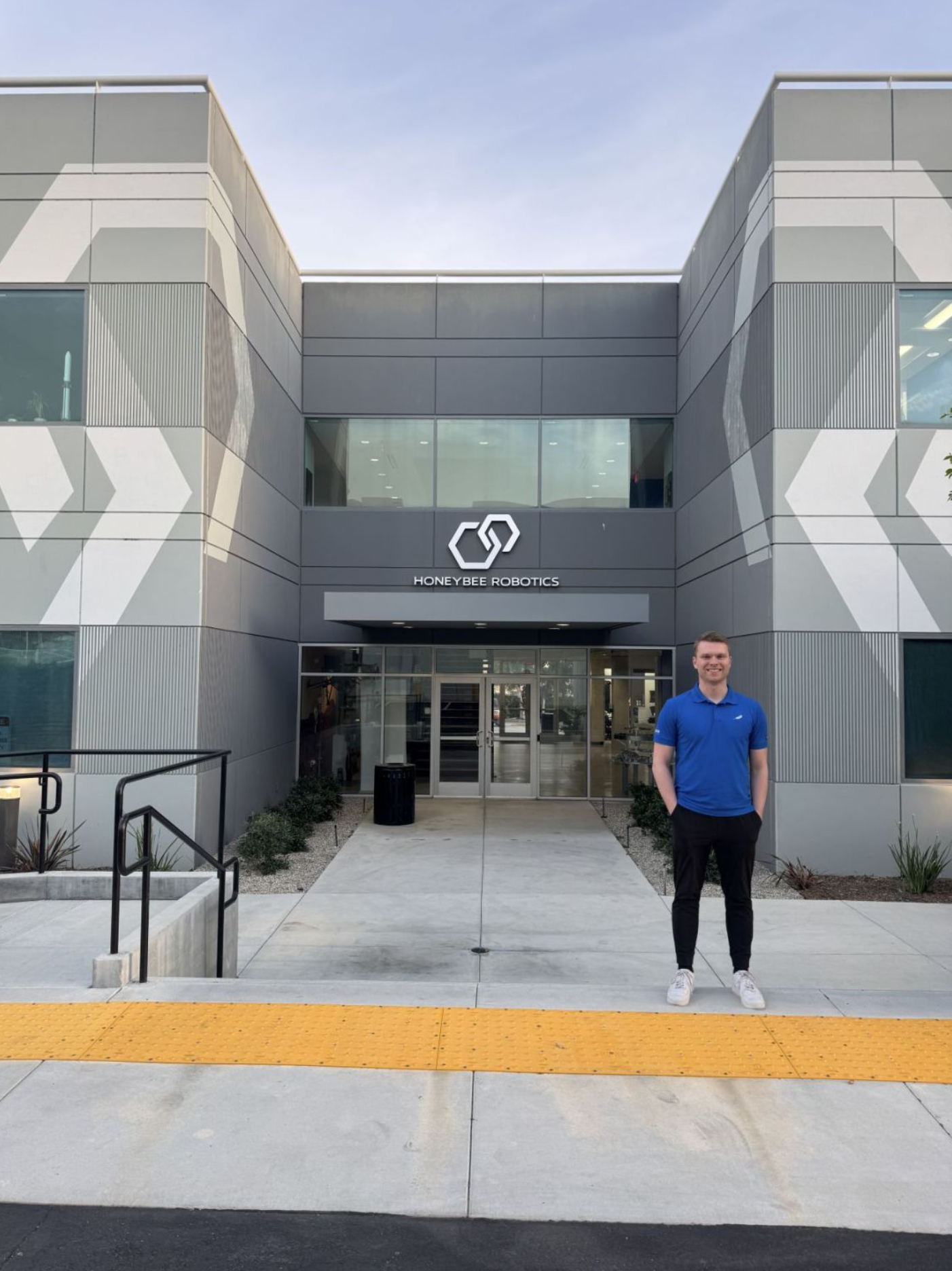
My Portrait in front of Honeybee Robotics (a Blue Origin Subsidiary) at the end of my Blue Origin Internship in April 2026 (Altadena, CA).
Where These Frameworks Come From
You'll recognize a lot of the ideas that I bring up here as being from some of the other articles I've written and posted on this website.
During my time at USC, I got to meet a lot of very successful people — founders, entrepreneurs, athletes, super bowl champion coaches, national champions, world-class sketch comedians/youtubers, and, of course, many successful engineers — and I learned their perspectives on how to be successful.
I was able to apply some of those principles right away, while some of the other advice took a long time to digest and figure out how to apply it to my personal life and career.
But eventually, through a lot of trial and error, I figured out what worked and I'm going to outline all of that below.
Rule #1: "Product-Market Fit" Is the North Star for Engineering Careers
I essentially stole this quote directly from Harry Gestetner, whom I met in February 2025 during my FanFix visit, where when asked how to create a successful startup, he said the most important thing is that:
"Product-Market Fit is the North Star for All Entrepreneurs."
In short, product-market fit is when you create something that a group of people or customers want and are actually willing to pay for, with a key indicator of reaching PMF being when your business grows organically and exponentially after a certain point without a ton of paid marketing or additional push behind it.
In careers, you similarly want to choose a career in something that there's strong demand for from the market — you want to build skills and talent in areas that companies are actually willing and able to pay for.
So for example, for me over the last year or two, my PhD topic had changed to Spacecraft Contamination. There's only a handful of contamination jobs out in the world though, so I wasn't getting any interviews for that since there's not much of a market for it, despite being a potential PhD holder and one of the best people in the world in that topic.
On the other hand, as soon as I started marketing myself as a GNC Engineer, I started getting interviews left and right, with some of those even leading to job and internship offers.
The reason for this is because almost every space company hires for GNC Engineers AND usually can't hire enough qualified GNC Engineers since it's a relatively rarified skillset.
If I go back to Harry's example — when he started FanFix, he had ZERO revenue for months despite the fact that they hired a Professional Dev Shop and paid $100,000 to create their app. But once they found product-market fit a few months in, they went on to make $17,000 in their first month, after which revenue approximately doubled every month thereafter.
Similarly, when you're picking a career and you pick one that there's significant demand for — where there's demand for your skills and far more of it than supply available — you'll similarly start to hit these type of "magic moments" that lead to explosive growth in opportunities, much like I started to get once I switched back into GNC and started landing interviews there.
To sum this point up: make sure you pick something that has a strong "product-market fit," and finding your dream job or internship will be much easier, rather than trying to "market a product" (skills) that companies aren't looking for.
Rule #2: The Passion Mindset vs. The Craftsman Mindset (a.k.a. "The Artist vs. The Professional")
In his book So Good They Can't Ignore You, which in my opinion is one of the best books on career development, author Cal Newport argues that there are two main ways of thinking about work and careers:
- The Craftsman Mindset – Focus on what value you are producing in your job, and what you can offer the world.
- The Passion Mindset – Focus on what value your job offers you, what you want to do, what you want from the world.
In other words, the craftsman mindset focuses on what you can offer the world, whereas the passion mindset focuses on what the world can offer you.
There are two primary reasons why Newport dislikes the passion mindset (beyond the fact that it's based on a false premise):
- When you focus only on what your work offers you, it makes you hyper-aware of what you don't like about it, leading to chronic unhappiness.
- The passion mindset presents you with ambiguous and often unanswerable questions such as "What do I truly love?" and "Who am I?" — which are essentially impossible to confirm.
In his opinion, the passion mindset is the wrong approach and is almost guaranteed to keep you perpetually unhappy and confused. On the other hand, he argues that the craftsman mindset is the foundation for creating work you love.
Along a very similar vein, Steven He in his November 2025 talk at USC which I attended actually came to a very similar conclusion, albeit from a different perspective.
His "The Artist vs. the Professional" analogy for thinking about careers — in this context, how to be a successful YouTube creator — almost directly maps to Cal's "Passion vs. Craftsman" mindsets. To pull directly from my article on Steven's talk:
It took himself a while to learn but is an important one.
It's the artist versus the professional.
What's the difference?
The artist expresses, and a professional delivers.
The difference is the direction.
The artist thinks "I want to make this story," "I think this is cool," "this is what I think is awesome..."
Whereas a professional thinks "how can I make this story for you," "what can I produce for you."
Sometimes the two will coincide, but Steven emphasized that if for the majority of the time you think of yourself as a professional in this sense (instead of an artist), you will be happy to do your job.
That way, when he made a video about emotional damage for the 227th time — instead of trying something new — he didn't get bored (even though he would with his old perspective) since that's what the audience wanted and kept coming back for.
What Steven says here is essentially verbatim for the concepts that Cal was teaching in regards to approaching your career. It's not about what you want, nearly as much as focusing on what you can provide other people, and then doing your best to continually get better at that every day.
To take this further, I also argue that this is all just a slightly different way of restating Rule #1, which is about focusing on Product-Market Fit. Product-Market Fit is essentially about focusing not on what you want to make, but on what'll resonate with a potential market of customers or companies which you're providing a product or service for.
For me, it was a very profound realization when I connected the dots and saw that three of these ultra-successful people from completely different backgrounds — Harry, Steven, and Cal — all came to the same conclusion about business and careers.
Rule #3: Accumulate Relevant Experience
After picking a career path or opportunity which is a good "product-market fit," the most important thing — at least in engineering — is to accumulate experience. Or, in other words, it's to gather evidence of competency or mastery in your given field.
For example, if you want to become a Spacecraft GNC Engineer or Intern, you need to have some type of Spacecraft GNC Engineering work on your resume.
Usually when you're just starting out - if you're in college or grad school for example - the best pathway is to volunteer in a professor's research lab at your school OR to get involved in an extracurricular club on your campus outside of your classes where you can get this type of experience — e.g. the CubeSat team or Rocket Team student groups at your campus.
Similarly, if you're looking to go to grad school and you want a full ride to a funded master's or doctoral program, you should have experience on your resume which lines up directly with the responsibilities of that role.
For example, I worked in a research lab in undergrad where I went on to publish two conference papers as a first author, which I believe directly led to my full-ride in my MS and PhD in Astronautical Engineering at my dream school, the University of Southern California. Since I'd already successfully done research and written papers as an undergrad — and done so at a high level — my future school likely saw that I had promise as a potential graduate student.
As a slight aside, I'll mention that in hindsight, I was VERY LUCKY to have the undergraduate research advisor that I did. While I didn't know these frameworks at the time, getting experience in his lab worked very well in my favor since his primary job was "to give space-related research opportunities to undergraduate students," of which NASA gave him $700,000+ a year to do.
Even in completely different fields such as Steven He with content or Harry Gestetner with starting a successful business, they both started from essentially no experience in those respective fields, but they had to start somewhere. Similar to me volunteering for free in a research lab eventually leading to my full-ride MS and PhD degrees 3 years later, Steven and Harry similarly worked "for free" in their respective fields for a while before they too reached their eventual breakout successes.
One point of clarification I'll mention as I close out this point is that for careers, you should have the experience that you're accumulating align as closely with your desired job as possible.
For example, if you want to be a propulsion engineer, make sure you get experience in propulsion engineering and not something completely unrelated like biology or contamination.
Occasionally, having impressive technical experience in an unrelated area will impress a company or interviewer and allow you to make a lateral move, but oftentimes you'll also lose out to someone who directly has experience in the thing you're after.
The best move is to gain experience directly in what you want to do instead of pursuing an unrelated or loosely related thing hoping it'll lead to the thing you really want. As with everything, there's always exceptions — the universal "80/20 rule" still applies — but to increase your chances in most situations, it'll be MUCH easier to land the roles you want if you have directly relevant experience instead of an eclectic blend of a bunch of different things.
Rule #4: Embrace Failure
When both Harry Gestetner and Steven He talked about how they became successful in their respective fields, they both mentioned that they took a lot of failures.
Harry had tried about 20 businesses before FanFix, and all of them failed. Even when he started FanFix, he went through endless iterations until he finally achieved PMF and subsequent success. Even before they got acquired, there were quite a few times where they nearly ran out of money.
Steven He mentioned that he got no views for his first 220 videos — then at video 221, he went viral for the first time after enduring over 200 failures. He saw some success here and there after video #221, but it wasn't until video ~300+ that his hit series — Emotional Damage — happened, which blew up his channel to where it is today.
Steven even mentioned that a lot of successful creators — Mr. Beast, Alan Chikin Chow, RDC World, and others — had several hundred or thousand failed videos (sometimes years even, before they got any traction) before they became successful.
I've seen this throughout my own life as well — comedy being one example (e.g. me going up on stage several times before I even got my first laughs, then got good after that) and finding a good job/internship being another.
With the latter, I applied to my Spring 2026 Internship company 12 times from my freshman year in 2019 to the 4th year of my PhD in 2025 before I finally got in on the 12th try. I even applied to the exact same GNC Intern posting for the Summer 2025 cycle and got rejected, whereas 8 months later, once I'd refined my application, learned to sell myself better, and maybe had just a little bit more luck, I landed the Spring 2026 GNC Intern position.
Rule #5: Learn To Sell
I won't go into details about this in this article since it's a very nuanced topic, but I highly recommend not only focusing on the technical aspects in Rules 1–3, but also learning how to sell yourself.
Sort of along the lines of Rule #2 — when you're interviewing or writing tailored cover letters and so on, always state what you can do for the company, what value you can bring, how you help them accomplish their goals.
On top of that, while definitely not always required, I personally think that increasing your charisma and general interview skills is also a good return on investment.
What worked for me was getting good at standup comedy — I outlined how in my article here. Performing in front of live audiences under live time pressure is one of the best ways to become charismatic fast.
In my opinion, if you can get to the point where you can command a stage, be witty, and make people laugh in real-time (and get through the initial stages of being bad your first few sets to get there), you're going to come across much more charismatic in job interviews. Comedy is one of the best training grounds for job interviews and selling yourself.
Rule #6: It's Not The Job You Get — It's What YOU DO With The Job You Get
One of the most profound things I learned during my time at USC came from a class I was lucky enough to attend called "The Game is Life," co-taught by USC Marshall Professor David Belasco, Dean Varun Soni, and NFL Super Bowl Champion head coach Pete Carroll.
Yes, Coach Carroll was A REAL professor at USC in Spring 2025! (See below)
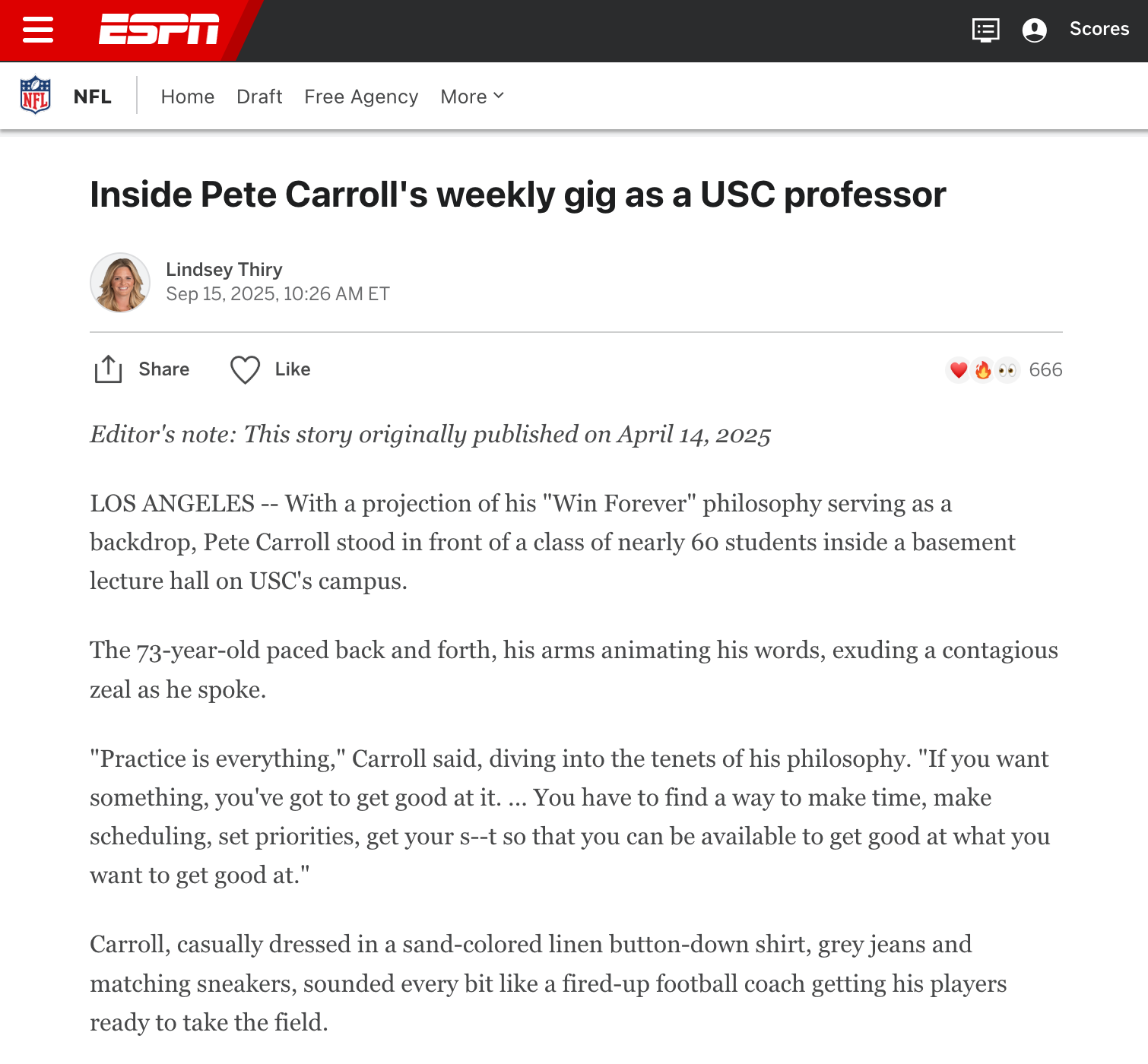
My favorite quote from the entire class — which I captured on video — was this:
"And all of the teachings that we're trying to stand for here, is to help you guys figure out that: It isn't about maybe the job that you get right now — it's WHAT YOU DO with the job you get!"
This completely reframed the way I looked at careers from this point forward.
A lot of conventional thinking about careers focuses heavily on getting the right opportunity: picking the right field, being at the perfect company, waiting for things to be perfect. And while it's awesome if you accomplish those things, those aren't the right things to focus most of your time and energy on if you want to become the best version of yourself.
Pete's paradigm throws all that conventional thinking out the window. You might not be at your dream company yet. You might not have the exact role you envisioned.
But that's not the point — and more importantly, that's not an excuse in his eyes. The point is what you do once you're in the room.
Two people can have the exact same job title at the exact same company and have completely different outcomes based purely on what they do with it. The ones who thrive aren't necessarily the ones who got the best opportunity — they're the ones who made the most of the opportunity they had.
You don't wait for the perfect situation. You create it, through the work you put in, the problems you take on, and the value you deliver wherever you are.
With Sam Freeman - who graudated from UCLA in 2024 and started his own 7-figure events business, he was just a nightclub promoter at 19 when he went up to Addison Rae's table and asked the people she was with how they became rich. He networked properly and used the promoting gig as a launchpad to other opportunities which eventually allowed him to start his own business while many other promoters didn't take advantage of that opportunity.
For me, I didn't get into my "dream" school for undergrad - USC was technically my dream school, but I actually didn't make the scholarship deadline so had I applied it wouldn't have been realistic to get a full ride scholarship for undergrad since I missed that.
Instead, I went to the University of Minnesota - a GREAT school for Aerospace Engineering - and made the most of the experience with the limited time and resources that I had, and I got into my dream school - USC - for my MS and PhD in Astronautical Engineering with a full ride as a result.
Doing well in my situation at the University of Minnesota, and at my public high school before that, led to all of the wonderful opportunities that I got to have at USC and in Los Angeles overall as a result.
On the other hand, there might've been people who went to a more prestigious high school (I went to a public school, not a prestigious private one) or undergrad college who might not have landed the same opportunities since it's about what you do with the job you get, as Pete says.
Overall, Pete's reframing was huge for me. Instead of just focusing on getting the "perfect" opportunity or role, the goal is to focus on making the best of the opportunity you have right now. And if you do that consistently, better opportunities tend to follow naturally.
The only caveat I would have here is that the stronger "product-market fit" you have with your career or situation, the more this advice will apply.
If you're trapped in an extremely niche career or field, the advice still applies but doesn't work as well as if you're in a good or even a decent field, in my opinion.
Once you pick something that's "good enough," the advice shines though.
Rule #7: Starve Distractions
I could write entire articles on this point alone — and many established authors and researchers have published articles, books, and a variety of other research on the topic.
But from a birds-eye view, just as important as knowing what to focus on is making sure that you stave out all of the distractions. Don't constantly check your phone, surf the internet, or spend your time on lower-value tasks — have strict boundaries around the usage of such things, and protect your deep work time for your highest value tasks.
The modern world — especially the internet and our smartphones — is engineered to take away and steal our focus, so it's critical to be aware of this and make sure that you set strict boundaries around the use of such devices and apps.
Cal Newport talked about this in his 2016 book Deep Work, and there are more recent books such as Jon Haidt's 2024 book The Anxious Generation and others which talk about how to train your focus and attention whilst avoiding distractions. Cal's blog and podcast have a lot of more recent resources surrounding training your focus along with regulating cell phone and social media usage/addiction as well.
Traps To Avoid
On top of the previous point which is about avoiding distractions, I'm going to briefly touch on some traps to avoid as you go along your journey - with the caveat being that this advice won't apply in all situations, even though it applies for most situations.
First, make sure you don't commit yourself to too many interests.
When I was in undergrad for example, I was technically on both the rocket team and in the high altitude ballooning lab research during my true freshman year, but eventually, I was overwhelmed and my attention was too fragmented in order to be exceptional at both, so I prioritized and focused only on the more important opportunity - the high altitude research lab - during my last two years of undergrad.
There's a quote along the lines of:
"If you try to be good at everything, you'll be great at nothing."
While there's certainly exceptions - you'll have to use your best judgement - one of my biggest regrets of my 9.5 years (so far) of college and grad school from ages 16-26 is that I didn't focus even harder on 1-2 specific things and let the compound effects of that build up over time.
Secondly, don't take too many unnecessary classes.
This sort of goes along with the first point here, but in much the same way that you shouldn't have too many disparate activities, you usually shouldn't take unnecessary electives as well.
While it was an honor and privilege to have had a full-ride scholarship at USC, the main drawback of that lack of financial pressure when it came to having free tuition is that it allowed me to take too many electives which ultimately didn't move the needle in my life or career.
For example, while all of the classes could be awesome for someone pursuing a career in these fields, I took electives in Spacecraft Communications, Advanced Spacecraft Propulsion, Blockchain, Computational Physics, Atomic Simulation of Materials, Liquid Rocket Propulsion, and more.
Again, I want to emphasize that all of these classes were awesome, but from a pure utility perspective, doubling down on 1-2 skillsets (e.g. AI/GNC and Content) and focusing my time on getting really good at those would've been a much better use of my time in hindsight than taking those additional classes - even though they were free.
The tuition might've been free - which I'm forever thankful for - but my time was not!
Lastly, don't listen to everyone's advice.
Over the last couple of years, I've asked A LOT of people for advice - whether I should finish the PhD, drop out, and regardless of what I should do there, where I should focus my career next.
Going through this frustrating period is actually sort of where I came up with the framework that I've created here in order to answer a lot of the questions that I've been asking myself.
And as I've asked people for advice, I've made a lot of observations.
First, people have a confirmation bias for the path that they took in life - so if they took a certain path, they'll often encourage you to follow it too, even if you yourself might have better options potentially available.
Secondly, you should always be aware of the person's biases or agenda. This isn't inherently a bad thing, but it's always good to keep in mind when you collaborate with people in life.
For example, when I had to completely switch my PhD topic 3 years in, I asked most of the professors I know for advice, and a couple of them even pitched me on either collaborating with them on their research or transferring to their lab entirely.
While it would've benefitted them to have me in their lab, those specific PhD topics or research labs likely wouldn't have set me up for my long term goals, so I thanked them but politely declined the opportunities.
And to dive into my personal finance background for a little bit - when I was applying to colleges for both undergrad and grad school, many of the schools that I applied to DID NOT offer me full-ride scholarships but would've gladly allowed me to take out massive student loans.
Luckily I'd built up options for myself (scholarships-wise) and graduated undergrad with no student loans and a $35,000-40,000 net worth, but had I listened to conventional wisdom and these universities, which said "take out loans! nearly everyone else does it!", I would've ended up benefiting the universities at my own expense.
Luckily though, through frugality and scholarships, I found a solution which benefitted both me and the universities I attended.
People will always try and do what's best for themselves, which doesn't always line up with what's best for you - BUT if you can find situations where the benefit is mutual, that's the best kind of situation to be in.
Jacob Pace, when speaking on a panel of successful entrepreneurs at USC in January 2025, gave a lot of good advice along this vein, including that:
the best relationships are ALWAYS going to be the ones where you both respect each other and see mutual value in each other.
Since he's in a cut-throat business environment (in the music industry specifically), he's a little more cautious around his business relationships, but the advice applies all the same.
Conclusion
To conclude this article, I'm going to bring a perspective that USC Alum and 100 Million Subscriber Sketch Comedy Creator Alan Chikin Chow brought up during his talk at USC.
To quote my own previous article, which paraphrased what he said during his talk, Alan Mentioned the following:
Alan also mentioned that he thinks that creating viral videos on purpose is EASY if you create what the platforms want from their creators.
While he's giving this advice in terms of being an online creator, I believe that this advice transcends into other domains -- like navigating your career, making content, starting a business, and so on.
Rephrased a different way, for engineering careers, "Landing your dream job or internship is much easier once you figure out what these companies want (and once you build up proficiency in those specific skills)."
So to summarize, my best advice here - inspired by both thought leaders such as Cal Newport and people I met at USC such as Steven He, Harry Gestetner, Alan Chikin Chow, Pete Carroll and more - is to figure out what the market (these companies) need, and to work hard to build up experience in those areas.
There's a famous quote in science and engineering, which is that:
All models (of the world) are wrong, but some are useful.
Which essentially mentions that no model is perfect - including this one.
There's nuances to every situation, but overall, through trial and error and through learning from some of the best people across different fields, I believe that this model is an excellent framework for making decisions early on in your career (and life).