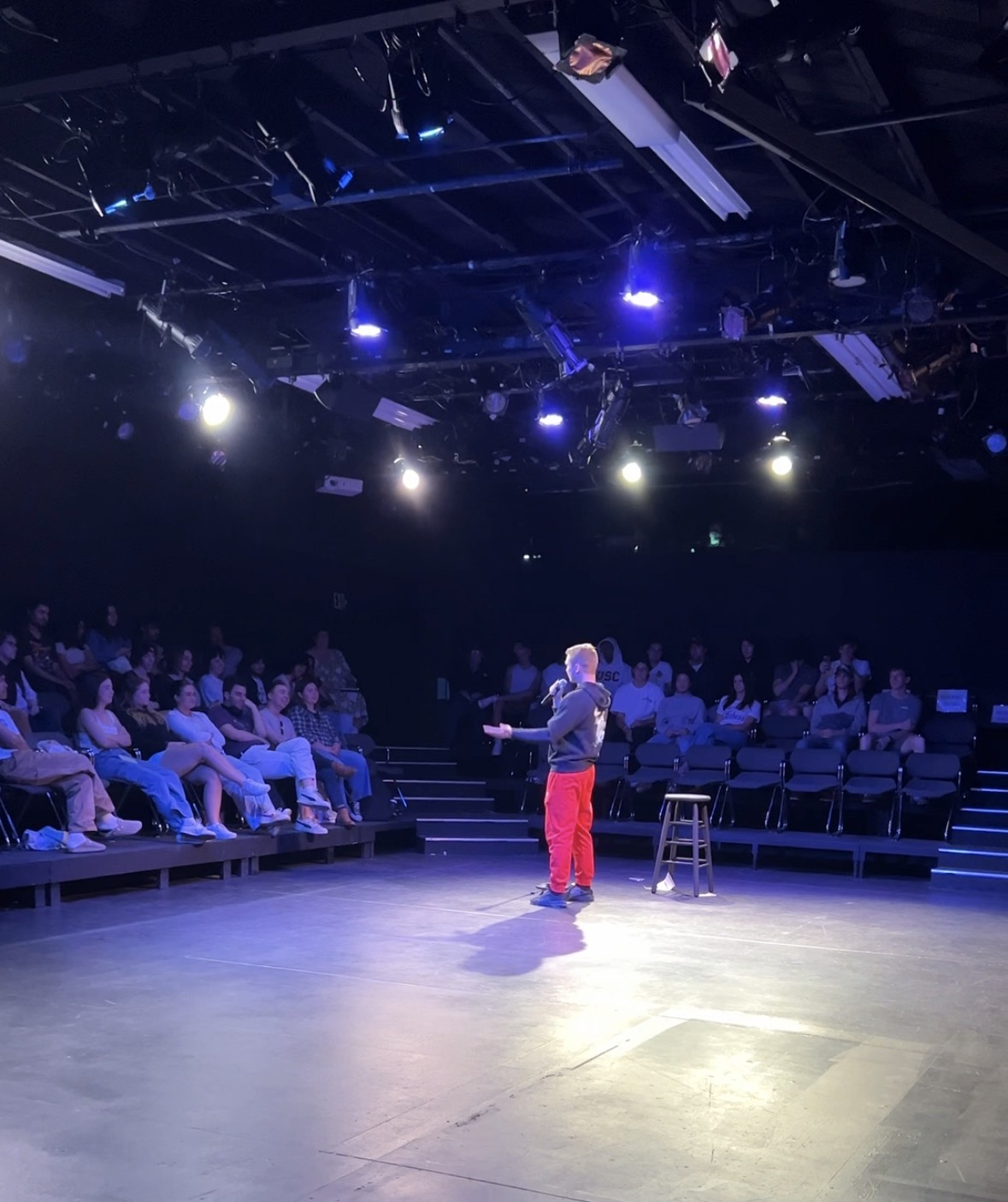
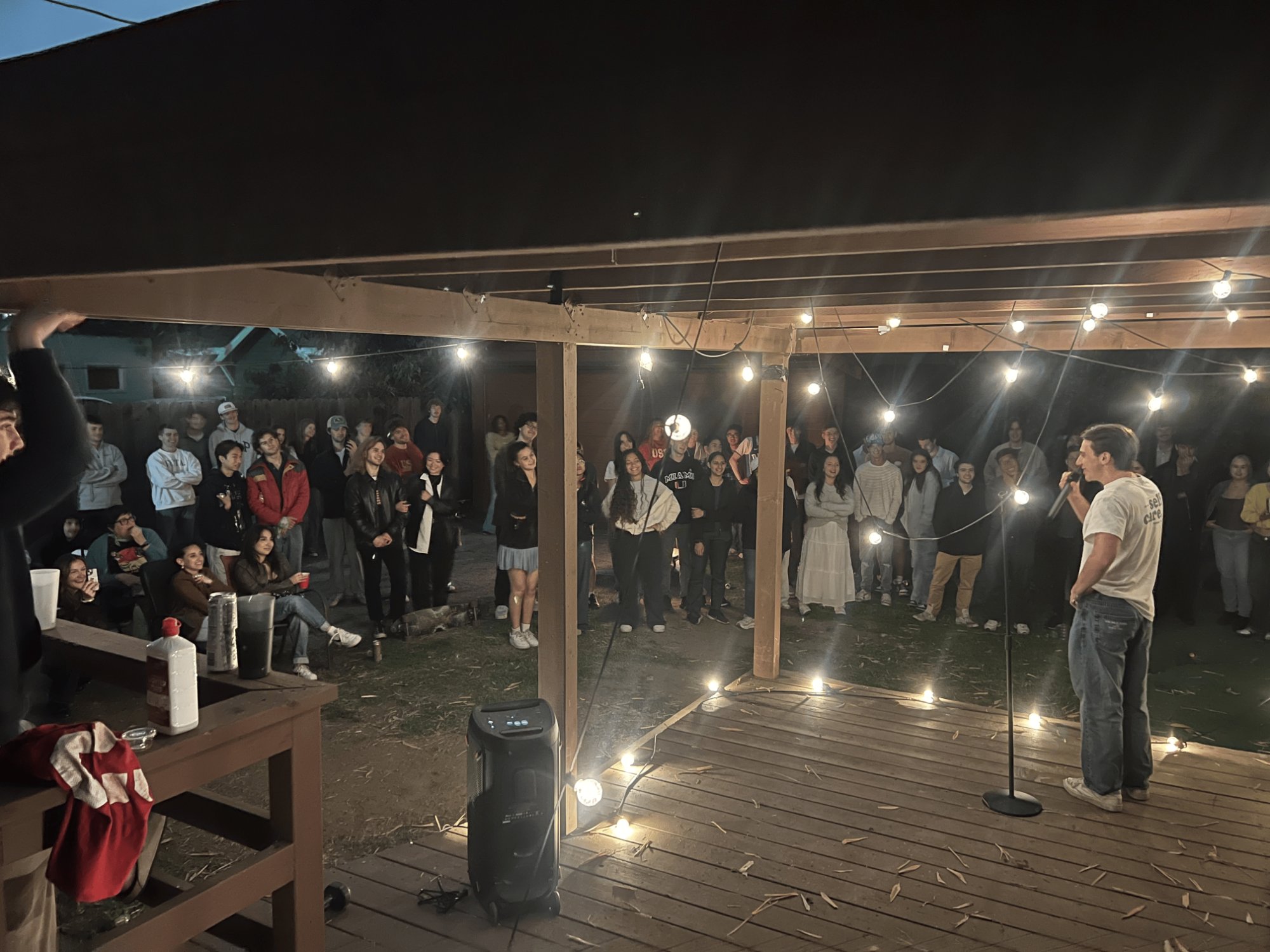
For the longest time, I remember always having the goal of ~eventually~ getting involved in standup comedy, but I honestly didn't know where to start. It was always something that I would do "one day."
And to be quite honest, it was also extremely daunting. If you do eventually take up standup, you will have nerves when you go up on stage and you might even bomb your first few sets - this is one of many fears I had going into it.
Once I got to USC at age 21 in 2021, I had the incredible opportunity not only to receive a top engineering education, but I also had the opportunity to take formal classes in comedy as electives and be involved in the USC and LA Comedy Scenes outside of class as well.
I unfortunately didn't get involved in comedy right away at USC - but I eventually got over my nerves and took THTR-474: Introduction to Standup Comedy in Spring 2023, and later THTR-482 Standup 2: Becoming a Pro in Spring 2025, and THTR-470: Sketch Comedy in Fall 2025.
As you can see from the titles of the classes, the two main forms of comedy that I got involved in were 1) Standup Comedy, and 2) Sketch Comedy, which are two different, but predominant forms of comedy.
Standup comedy is, as it suggests, comedy written and performed by an individual in front of an audience, usually by themselves and with a microphone, although there are some nuances and exceptions.
Standup is usually the type of comedy you see in places such as the Comedy Store or Laugh Factory, or in monologues of late night comedies such as Jimmy Kimmel or David Letterman for example.
Sketch Comedy, on the other hand, is usually not individual, but is comedic material consisting of multiple characters in a particular scenario, typically written and performed by a group of people. Late night shows like Saturday Night Live (SNL) are a prime example of this type of comedy.
Why Do Comedy?
Before I dive into how to get started and where to focus if you want to get involved in comedy, I'm going to briefly touch on why I believe that getting good at comedy is important.
In my opinion, having a good sense of humor and becoming funny is one of the highest ROI life skills that anyone can have. It's the best way to become more likeable, have better career prospects, relationships, friendships, overall happiness, and so on and so forth.
In my opinion, comedy is also the ultimate form of public speaking and communication, so if you can get really good at comedy, then I believe that it will carry over into many other aspects of your life and success as well (as I also alluded to in the previous paragraph).
Quick Overview: My Journey
For the longest time, I personally couldn't quite crack the code on it. I'd been very focused on school and academics all the way from 9th grade all the way through starting college at 16 and finishing my bachelors degree in aerospace engineering at age 21.
For a brief time, around fifth grade roughly, I was apparently very funny for around a year or so (probably because I watched A LOT of late night comedy then), and then that changed for some reason once I made the transition to middle school, and afterwards, I often joked that I "peaked" comedically in fifth grade when (jokingly) explaining my lack of a sense of humor.
Once I got to USC and took my first Standup Class at age 23, and later Standup 2 and Sketch Comedy at age 25, all of that changed.
I had the incredible opportunity to develop this aspect of myself while also being surrounded by incredibly talented classmates and professors, who all helped my development tremendously.
In the sections below, I'll give some of my biggest takeaways from my experiences doing comedy at USC - since they're still fresh as of this writing in December 2025 - and talk about how to actually become funny (through standup), even if you're starting from scratch like I did.
Strategies To Become Funnier
For someone just getting started, if I had to narrow it down to a few things, here's what I'd focus on if I want to either get involved in comedy and/or just become funner overall, while doing so as fast as possible.
- The Fundamentals + The Best Joke Style to Focus On
- Surround Yourself With Other Talented Comedians
- Practice, Practice, Practice
- Memorize, Memorize, Memorize
Bonus Discussion Includes:
- Use it or lose it!
- Deep Work & Comedy
- The Science (The Learning Curve)
Without further ado, let's dive right into it.
Fundamentals + Best Joke Style
There's a lot of joke styles that you can master, but the best bang for your buck is going to be focusing on and getting REALLY GOOD at a particular joke style, which are "late night monologue jokes."
Essentially, late night monologue jokes are - you guessed it - jokes which late night hosts perform individually during their monologue at the beginning of their shows.
The main reason why mastering this joke style is the best way to get funny is because these jokes are designed to be appealing and funny to ~80%+ of the population (except for the ones about politics...), since late night shows live and die by their ratings, and in order to have good ratings, late night shows need to have GOOD jokes which are appealing to the vast majority of the population.
In short, late night monologue jokes are the building blocks for virtually every other type of comedy.
Once you get good at late night monologue jokes, you'll be able to master other comedy types very quickly.
Another, much smaller reason, is that late-night TV writers have to crank out hundreds or more of these types of joke on a daily basis, so they essentially have the process of late-night monologue joke writing down to a formula and a science, which is very helpful for someone like me who is an engineer.
In my Standup Comedy 2 Class, my professor (same professor as my standup 1 class two years prior) gave us a textbook which outlined the process for writing late-night monologue jokes and the Book was incredibly helpful!
The book is called "Comedy Writing For Late Night TV" (2014) by Joe Toplyn, who was a writer for several late-night shows like Late Night with David Letterman and the Tonight Show with Jay Leno.
Chapters 5 and 6 - which are about writing and editing late night monologue jokes, respectively, are the two chapters to focus on here.
The rest of the book is incredibly useful and insightful, but reading through and mastering the Fundamentals taught in chapters 5 and 6 will make you very good at writing late night jokes, which in turn will make you much funnier overall in different situations and in life (once you combine those fundamentals with the other stratgies outlined below).
I highly recommend purchasing a copy of the book from Amazon.
However, I'll also summarize some of the very high-level points here just to give you a feel for what's taught in the book (although he goes into much more detail in the chapters).
The main points of chapter 5 (monologue joke formula) are:
A prospective writer for a comedy/talk show has to know how to write topical Monologue jokes because:
- On some comedy/talk shows, every writer is asked to contribute to every comedy piese, including the Monologue
- Monologue-type jokes are the main ingredients of many other pieces on a comedy/talk show.
- Most of the techniques used to write Monologue jokes also apply to writing jokes outside of comedy/talk shows.
Writing Monologue jokes is easier when you know the formula. It starts with the three parts of a joke: the topic, the angle, and the punchline.
The topic--It's a concise statement of the news item that the joke is based on. A good topic has six characteristics:
- A good topic is factually true.
- A good topic is not intentionally funny.
- A good topic is only one sentence long.
- A good topic is a news item that will capture most people's interest. Here are four signs that the news item will do that:
- The media are covering it extensively.
- Even people who aren't media professionals are talking about it.
- You yourself have an emotional reaction to it.
- At least one media outlet carries it as Odd News.
- A good otpic is something that your audience will let you joke about. you may be able to write acceptable jokes about an otherwise objectionable topic if you:
- Avoid calling to mind the most disturbing aspects of the topic.
- Remember that comedy equals tragedy plus time.
- Remember that comedy equals tragedy minus emotional connection.
- Don't make fun of people for things they can't help.
- A good topic is something that your host is willing to joke about.
The angle-- It's the middle part of the joke and sets the particular direction the joke will take in getting from the topic to the punch line. It's at most one sentence long.
Any given topic can spawn more than one joke, each with a different angle. Sometimes you crrate the punch line first and then construct an angle to get to that punch line. Other times, you try different angles first and see which inspires the funniest punch line.
The punch line--It's the word or phrase at the end of the joke that results in a laugh. The punch line must be surprising. It must also be true in the sense that the audience must agree with what the punch line is saying.
The six Punch line Makers allow you to create punch lines that are both surprising and true. They are:
- Punch Line Maker #1: Link two associations of the topic.
- Punch Line Maker #2: Link the topic to pop culture.
- Punch Line Maker #3: Ask a question about the topic.
- Punch Line Maker #4: Find a play on words in the topic.
- Punch Line Maker #5: Visualize the topic.
- Punch Line Maker #6: State the obvious about the topic.
To create a punch line based on any given topic, start with Punch Line Maker #1 and go down the list. your task will be easier if your topic is fertile - that is, has a lot of associations. Once you're worked out the three parts of your joke, jot them down in a rough draft.
Now it's time to fire up the left side of your brain, the more analytical side. If you used pencil and paper for your rough draft you may want to switch to a computer for this step, to signal to your brain that it needs to start thinking a different way. You still have work to do because the rough draft of a joke is like a rough diamond. It's valuable as it is, butto maximize its value you have to cut it a certain way, minimize its flas, and polish it to a sparkling brilliance. Only then will it have the powerful impact on people that you want it to have. You need to edit your joke. Toplyn shows you how in the next chapter (which I provide the high level summary for, but you'll need to purchase the book for in order to read in-depth).
The main points of chapter 6 (editing jokes / joke maximizers) are:
To make your jokes as funny as possible, edit them using Toplyn's twelve Joke Maximizers:
- Joke Maximizer #1: Shorten as much as possible.
- Joke Maximizer #2: End on the laugh trigger.
- Joke Maximizer #3: Backload the topic.
- Joke Maximizer #4: Make everything clear.
- Joke Maximizer #5: Don't telegraph the punch line.
- Joke Maximizer #6: Make the punch line parallel.
- Joke Maximizer #7: Use stop consonants, alliteration, and assonance
- Joke Maximizer #8: Wildly exaggerate.
- Joke Maximizer #9: Get specific.
- Joke Maximizer #10: Use the Rule of Three.
- Joke Maximizer #11: Don't be too on-the-nose.
- Joke Maximizer #12: Consider an act-out.
After you've polished your joke with the Toplym Joke Maximizers, subject it to these five Comedy Quality Tests to make sure it's ready for public consumption:
- Comedy Quality Test #1: Read the joke out loud.
- Comedy Quality Test #2: Imagine the host delivering the joke.
- Comedy Quality Test #3: Imagine the audience hearing the joke.
- Comedy Quality Test #4: Try the joke out on other people.
- Comedy Quality Test #5: Ask yourself if the joke seems familiar.
These tools and the tools given in Chapter 5 of Toplyn are very versatile and can also be used to write monologue jokes with visual punch lines, and, as you'll see, can also be used for most comedy, incling in your everyday humor and in short-form videos as well.
Memorization + Examples
I'd highly recommend reading Toplyn Chapters 5 and 6 all the way through several times, both as you get started and as you progress to these later stages.
Making flashcards for key concepts and having all of those down (e.g. why these jokes work, the three elements of a joke, the 6 punchline makers, etc.) is a good next step to master the basics after your first few read-throughs.
That will provide a really good foundation and understanding of how to get good at late-night monologue jokes (and humor in general as a result), but you'll also need to go beyond the textbook and implement the following strategies in order to truly get good at comedy, in my opinion.
The first strategy which I'll outline - slightly out of order from my list above - is that you should memorize your jokes, particularly the good ones from your set and good examples that you come across.
It's one thing to read from a textbook, or even write a few good jokes here and there, but I PROMISE YOU, that memorizing GOOD jokes from your set or GOOD example jokes is the BEST way to get better FAST, especially once you've red the textbook and understand the fundamentals.
We had to memorize our entire final exam set in Standup Comedy 2, and while I made some progress throughout the semester, I always rehearsed my practice sets in-class from written notes I had on my phone or computer, but I never memorized my set until the final set, when we all were required to by the professor.
I spent several days painstakingly memorizing the jokes before my final set, in order to make sure I had it down before actually performing it; and let me tell you, while it was very hard to memorize, but I became very focused and my brain's pattern recognition and neural networks did their magic and formed new connections which made me much more naturally funny going forward.
I don't know the exact underlying neurochemistry - I'm not a neuroscientist - but I've learned and mastered A LOT of hard things over the years (aerospace engineering, comedy, etc.) to know anecdotally how the brain learns, and learning from GOOD examples and memorizing those examples is one of the best ways to learn well and learn quickly.
The main takeaway is that once your jokes in your set become GOOD, you should memorize them since memorization is one of the best ways to become good at something quickly and well. Furthermore, one strategy which you can also use to shortcut this process is to find other monologue-style jokes which you think are hilarious and memorize them too.
Whether it's the examples given in Toplyn Chapters 5 and 6, or monologue jokes from your favborite late-night host which likely follow this formula, or similar jokes that you've heard from real life and written down, memorizing those can tremendously accelerate your own development and sense of humor.
In spring 2025, I took an artificial intelligence class at USC alongside my standup comedy class, and while LLMs aren't fully analagous to human brains, one of the bigest takeaways from the class is that LLMs need good examples, and A LOT of them ("training data") to get good at something, and I believe that, through my own experiences, this model applies to human brains and learning as well.
The more good examples you memorize of something and/or are able to solve it without looking at notes or outside references, the faster and better you will learn.
Personally, I saw this concept when I had to memorize my final set near the end of my Standup 2 class, and in other areas of my life like my PhD Screening Exam, where my knowledge of Aerospace Engineering and understanding of the concepts taught on the exam (Orbital Mechanics, Space Systems, Rocket Propulsion, Plasma Physics, Space Environment, etc.) significantly increased from that point on since I had to memorize all of the concepts and equations for those classes and be able to do a variety example problems from those courses completely from memory with no outside equation sheets or references under extreme time pressure.
If you apply this while learning the fundamentals taught in toplyn at the same time along with everything we'll discuss below, you'll get very good at comedy very fast, even if you start in a spot like I was in with little to no comedic abilities!
Practice, Practice, Practice
I think that this one goes without saying, but while I think that learning the Toplyn Chapter 5 and 6 fundamentals and memorizing a lot of good material are the two cornerstones of getting better, you have to actually get up and perform in front of an audience over and over in order to actually get better.
You'll learn - and proably fail - a lot by actually geting in front of the mic, but it's a requirement in order to get better at comedy as fast as possible.
You'll also learn a variety of different things, including that different audiences and people react completely differently to the same sets of jokes, and there's a lot of other things you'll have to work through like nervousness, delivery, pacing, and so on and so forth, which you'll adjust to and refine through actually practicing, experimenting, and making adjustments as you go.
It's sort of similar to being a professional athlete and playing in a game versus just doing drills in practice. Mastering the fundamentals and executing the drills at a high level is usually critical, but after that, the best way to get better is to play in real games. And "game speed" is often much faster and games are more dynamic than practice or drills usually are!
Once you get really good at comedy, you'll also start being able to crack good jokes on-the-fly in your everyday life and that's a good place to "practice" as well, once you get good at it, at least!
Surround Yourself With Other Incredibly Talented People
When I did comedy at USC - widely considered either the top or among the top schools for acting and comedy in the world - I had the immense privelage of both having top-notch professors who worked with top actors and comedians in hollywood and having classmates who were both incredibly talented actors, actresses, and comedians, and also in the same 18-25 age range.
Having talented people around you likely works for a few reasons - first, there's the common but famous phrase which is that "you're the average of the 5 people you spend the most time with." And I definitely agree that this spills over into skill development such as comedy, particularly when you're equipped with the other strategies here such as mastering the fundamentals and memorizing good examples.
While there's a lot of other reasons why being surrounded by talented people works well, one other point I want to highlight is that you're able to get feedback and fill in each other's gaps in your knowledge very quickly.
You're able to pick up on the ways that others might do things, which you can then incorporate into your own humor/comedy, and you also often get direct feedback which you're able to implement as well.
A more broad example which illustrates this concept is an example which I heard on author Cal Newport's "Deep Questions" podcast, where a listener asked how they should go about pursuing a career in Hollywood (specifically, I think they wanted to be a director, if I remember right).
In his response, I remember Cal Newport driving home the point that "in order to become a good artist, you have to be surrounded by other artists...", and I believe that this point is very applicable to comedy as well.
Being surrounded by incredibly talented people who were all much better than me at this is a cheat code and was incredibly helpful for my development, and I am incredibly thankful for the opportunity to have done this at USC.
Bonus Section: Use it or lose it!
To illustrate this concept, I'll give a quick story: After I had my final set for Standup Comedy 2 in Spring 2025, I was incredibly funny, even in everyday life, for ~1-2+ months afterwards.
In comedy terms, it was like I'd peaked for a marathon, and the peak lasted for that ~1-2 months afterwards before I started becoming slightly "deconditioned" thereafter.
After that 1-2 months, my baseline sense of humor was still MUCH better than it was before taking up comedy, especially depending on who I was with, but for the 1-2 months after my final set, my everyday comedy and sense of humor was on a very high level that it wouldn't have been otherwise.
While I was already substantially improved and remain so to this day in terms of my sense of humor compared to before, I definitely started losing some of that "peak form" as the summer went on since class was over and I wasn't doing comedy sets outside of class (and memorizing them, etc.).
The main takeaway is that you have to keep on implementing these strategies and that you have to keep "using it", otherwise you'll lose it over time as well.
Similar to building muscle, it may be the case that "maintenance" requires a lot less effort than the initial buildup or "bulking phase", but either way, it definitely takes effort to maintain your comedic muscle.
Even Jerry Seinfeld, the legendary comic, took several years off of doing shows after the pandemic in 2020, and when he first started doing shows again, he mentioned how he was extremely nervous and even HE, of all people, was "out of shape" comedically and intimidated by going up on stage, even though he'd been one of the best and most famous comedians for decades beforehand.
Bonus Section: Deep Work & Comedy
Professor Cal Newport is the author of the famous book "Deep Work," which is a book that essentially argues that "Deep Work", which is the ability to have distraction-free, focused concentration on cognitively demanding tasks, is essential for producing high-quality output and mastering complex skills in the modern world.
Without going into too much details on the technical aspects of "Deep Work," I strongly believe that Deep Work is crucial for mastering the skill of comedy effectively.
Whether it's going through flashcards, or reading Toplyn, or writing jokes or participating in an in-person comedy workshop, it's crucial to have 100% of your focus on the task your working on while simultaneously avoiding distractions, particularly digital distractions, notifications, social media, context switching, etc.
Cal Newport makes a lot of good arguments in his book regarding all of these, and I highly recommend that you incorporate all of his "Deep Work" principles in your comedy work as well.
In other words, life will present you with A LOT of opportunities for more expedient or short-term gratificaiton and shallow (unearned) dopamine. You have to get really good with DELAYING these short term gratifications and distractions in order to have the best chance at being successful here (and in life in general). You know what those are - avoid them.
Bonus Section: The (Scientific) Learning Curve
This section will be a quick overview of the science behind human learning, specifically the theoretical “learning curve,” which is a theoretical exponentially decaying curve of human performance vs time. This is a concept which NASA uses in its Astronaut and Flight Controller Trainings and it contains several very important lessons related to learning optimally.
The learning curve is as follows:
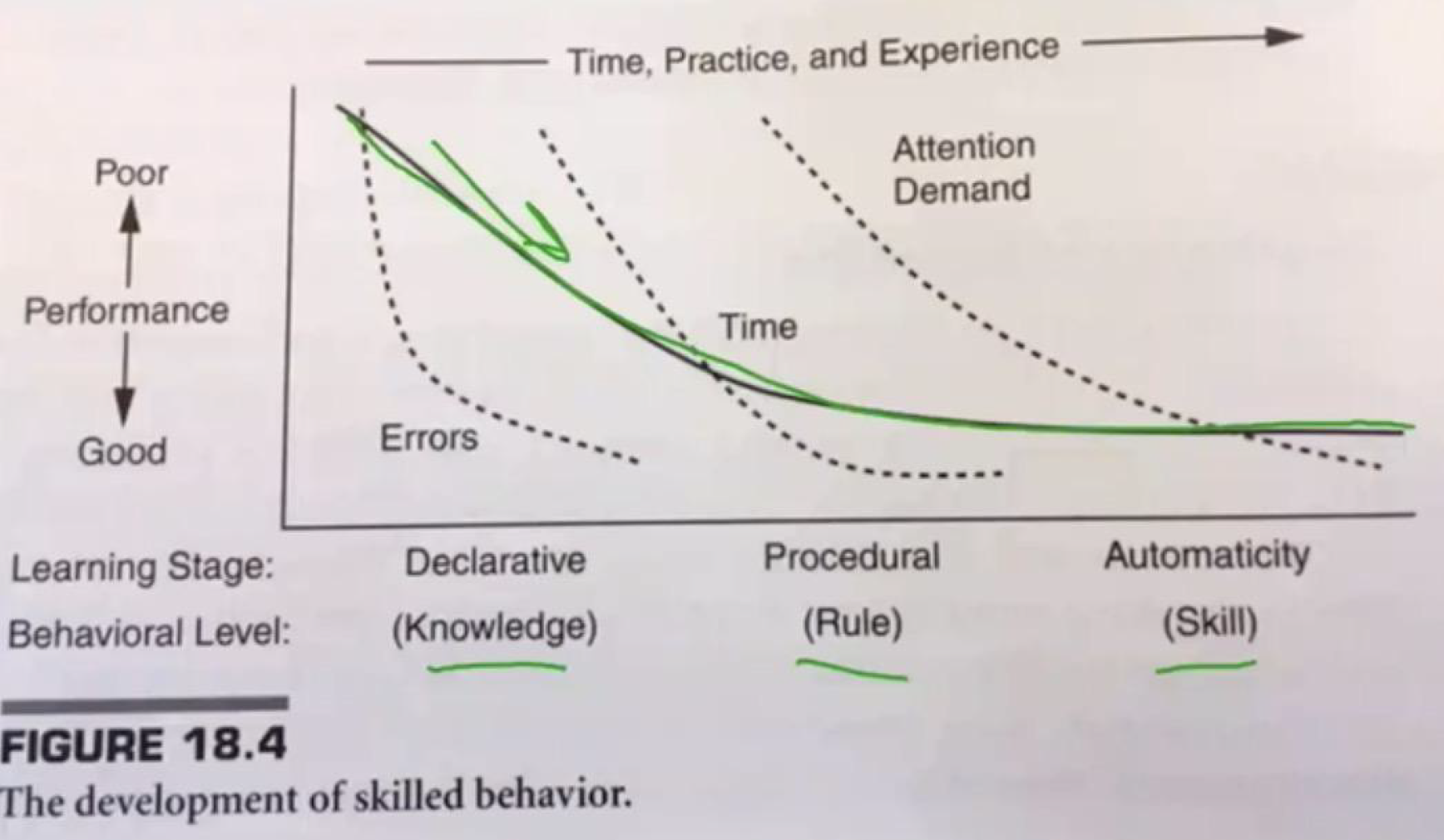
Source: (Wickens, C.D.; Lee, J.D.; Liu, Y.; and Becker, S.E.G.; An Introduction to Human Factors Engineering (2nd edition), Pearson Prentice Hall)
As seen in the figure, learning tends to proceed through three stages over time: from “knowledge-based” to “rule-based” and finally to “skill-based” capabilities.
However, different performance aspects of the task tend to emerge at different times as shown by the dotted lines: 1) in the initial declarative (knowledge-based) region, where there’s initially high error, but those tend to decrease as you perform the skill, then 2) after errors are eliminated, performance time improves in the procedural (rule-based) region where you can perform the task accurately, albeit at a slower speed initially, and 3) finally, in the automaticity (skill-based region), the attention required for the task decreases until automaticity is achieved, and you’re able to complete the task quickly and with little effort.
In terms of its technical definition, automaticity means that the task becomes a “background task” and it frees up cognitive bandwidth for simultaneous execution of other tasks or for improved situational awareness.
The implication of this on your Comedy Progression is that your skills and proficiency will follow this learning curve and overall process very closely. You won’t be very good at first, but then as you practice and use the processes I outlined in this blog articles, you’ll initially reduce errors and be able to solve the problems, then as you solve the problems correctly, you’ll start reducing the time it takes to solve the problems, and once you do that enough times, you’ll ideally get to the point of automaticity, where solving these problems becomes automatic and you’re able to solve them correctly without much time OR effort.