Intro
There’s a piece of advice from Cal Newport – an MIT PhD and the author of the famous books “Deep Work” and “So Good They Can’t Ignore You” – that I think about all the time which has helped me to make hard but objective career decisions over the last 1-2 years.
That advice is that: when evaluating the viability and efficacy of career and entrepreneurship decisions, one principle to stick by is:
to use money as a neutral indicator of value
It’s something that he talked about in his 2012 book on careers called “So Good They Can’t Ignore You.”
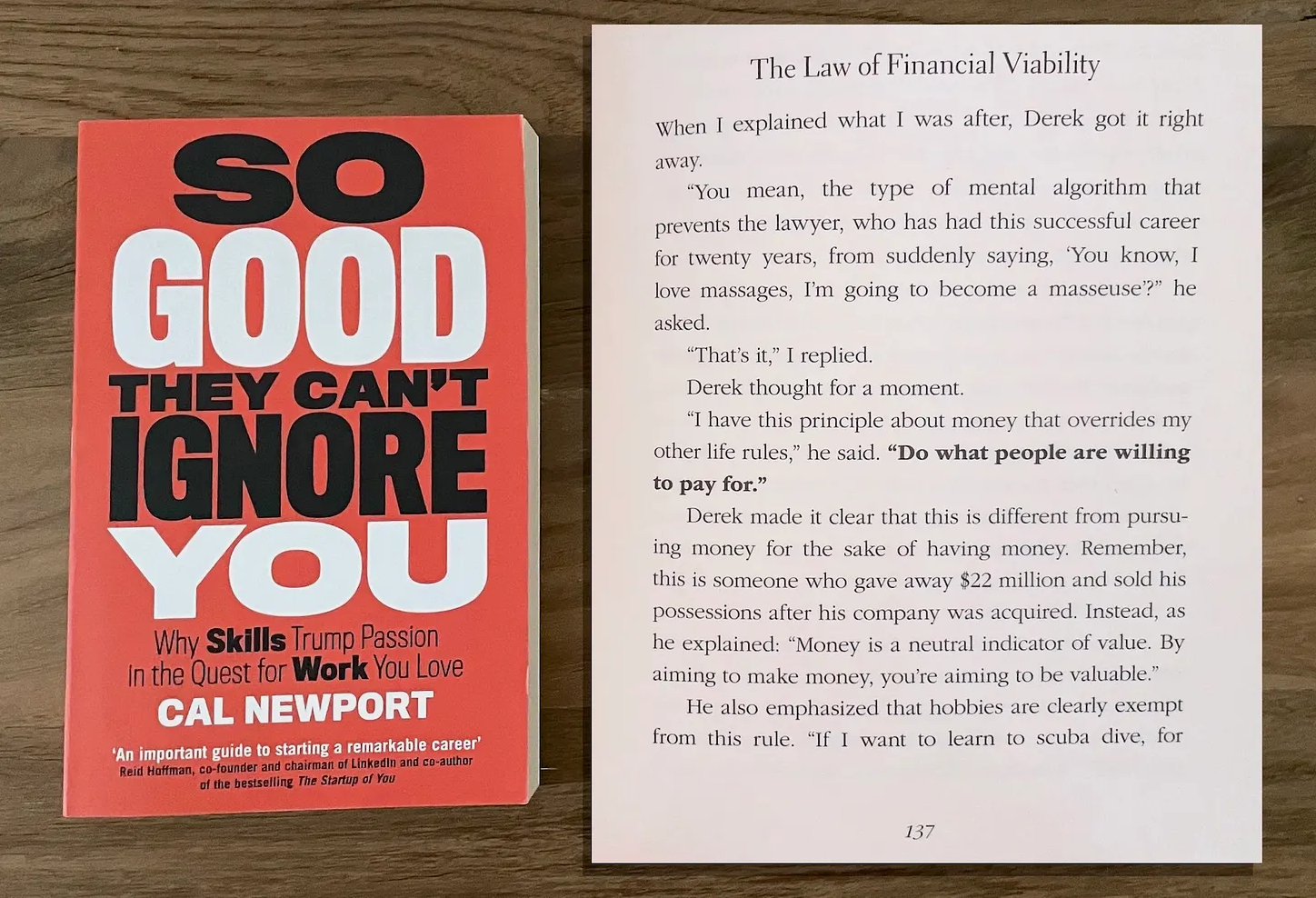
The section on “The Law of Financial Viability” in Cal Newport’s “So Good They Can’t Ignore You.”
It’s a term coined by entrepreneur Derek Sivers, and is basically the way that you de-risk changes in your career and make decisions more soundly.
Cal calls it “The Law of Financial Viability” in his book.
It’s a very good hueristic for deciding whether you should leave your 9-5 job for a more entepreneurial venture, or - in my opinion - a good way to evaluate career paths within a traditional career itself if you’re initially unsure of which one to take.
(after all, pursuing a traditional corporate path can be just as lucrative if not moreso than owning your own company – despite the online hype towards the latter)
All-in-all, Cal argues that using money as a neutral indicator of value is a good way of evaluating whether a business idea (or a career path) is good.
I think it’s a very powerful concept so let’s dive into what it means and some examples.
What It Means
Cal mentions in his book and in several episodes that the main thing with the law or financial viability, i.e. “using money as a neutral indicator of value”, is that:
You look to see if you can make money on the new thing.
Crucially, don’t just trust your gut, don’t just ask people their opinions on whether you should start this new thing or not.
You instead, on the side, start doing to a reduced degree, the thing you are considering, and see if people will give you money.
Because here’s the thing: it costs people nothing to compliment you, or tell you that something is a good idea, it costs them nothing to fire you up about “going big” or “betting on yourself.”
But if you ask for people’s money, that’s different! People are different about (giving away) their money.
People are not going to give you their money unless they value what they’re getting.
So what Derek Sivers said - as I alluded to before - is that using money as a neutral indicator of value is a way of evaluating whether a business idea is good.
With a business – Can you get clients? Will they pay you? Can you sell these things?
With a career – are people hiring for this job/specialization? Can you land interviews? Can you get hired easily? Does it pay well? How is it compared to adjacent or other alternatives?
Overall, it’s a simple yet powerful way to make big career and business decisions and is something that’s helped me myself become a lot more successful recently.
The Algorithm
Newport - in his video below - mentioned that the “algorithm” of the law of financial viability is roughly as follows:
- Get a specific idea
- Run it on the side
- See if you can make money
This was for side-hustles specifically, but if you’re testing potential career paths, then the algorithm is still very similar.
In the context of the conversation, Cal was taking a question from a listener who was asking about potentially making the entrepreneurial leap and very fearful and anxious of making that change (as many of us can be).
He said that if you’re making enough money to live off of, then you won’t have the fear, or your fear will at least be greatly diminished.
And if you aren’t making enough money to live off of with one path, then that’s a great signal, that means to NOT pursue that path (at least not now), don’t go try to do this new thing.
Cal went into more detail in this clip below:
Some Examples
Within my career recently, as I’ve detailed extensively on this blog, I’ve used this to evaluate my own career choices recently – namely, whether I should continue my PhD or drop out and pivot.
Society would say to “finish the PhD,” and that it’s “the proper thing to do,” and that “it’s the next logical step in the academic ladder” and so on, but economic realities spelled something totally different for my specific doctoral program.
My PhD lab was a plasma physics lab - and outside of some extremely rare exceptions - plasma physics doesn’t usually lead to a compelling career, nor do plasma physics labs bring in a lot of money (maybe I’ll be proven wrong if/when there’s a breakthrough in fusion physics, although the “breakthrough” has been “only 20 years away” for 60+ years!)
As such, my entire PhD was marred by constant funding instability and worry about money. I had to be a Teaching Assistant (TA) all the way through in order to pay for my tuition and stipend.
Getting to teach classes such as Orbital Mechanics, Spacecraft Systems Engineering, and so many others at USC, was the honor of a lifetime and a great joy, BUT at the same time, it also took away time from my own PhD research and overall PhD completion timeline.
This was compounded by the fact that my PhD lab had absolutely zero money – everything I did in my PhD was centered around computational simulations, not experiments – since we had no money for experiments.
If our lab had the money for experiments, that would’ve made my PhD progress and overall learning go much faster since experimental validation is a great compliment to simulations.
But this wasn’t the case – and after three funding switchovers and topic switches in the first three years, and with my third and final topic, spacecraft contamination, not “contaminating” me with any job offers, I made the hard decision to pivot after four years.
Harkening back to Cal’s point in his video about either sticking with a path or pursuing a new path because it seems like the “romantic” thing to do, I was very attached to the idea of finishing out my PhD because I absolutely loved everything about USC – except my PhD research.
For the last 1.5-2 years especially, a lot of alarm bells were going off in my head and I constantly thought of dropping out – not because of difficulty or workload, but because of efficacy.
Because I’d both “wasted time” through sunk cost and because finishing the PhD was the “right thing to do,” I constantly had the anxiety of potentially having to drop out that had exponentially grown over time.
The longer I looked at the situation, and especially now in retrospect, the more I realized that there was zero value in studying contamination or plasma physics specifically.
It’s possible that things might’ve worked out had I tried to finish the contamination PhD, but I also have a strong feeling that continuing down this PhD path might not have worked out so well due to the law of financial viability.
On the good side of things – the fields that I did pivot to: Guidance/Navigation/Control, Autonomy, AI, Machine Learning, Robotice – these all are very financially viable.
With GNC – which is what I did my recent Blue Origin Internship in – nearly every space and aerospace company hires for them, and not only does everyone hire GNC Engineers, but they’re by far the highest compensated as well out of most aerospace engineering specialties (tied for first place with software engineers).
As I’ve mentioned countless times by this point, I had zero interviews in the first four years of my PhD studying plasma physics and spacecraft contamination.
But when I successfully pivoted to GNC with my Blue Origin GNC Internship, I subsequently interviewed with 30+ different space companies in the following year. I also received a handful of offers out of those 30+ different companies for pretty good pay!
In a way, I was doing my “main thing” (my contamination PhD) while “running experiments on the side” (building my portfolio for, and applying to GNC jobs) before eventually landing one, getting a lot more traction in my career in it, and pivoting once that significant increase in traction was clear.
On the other hand, the PhD in contamination didn’t seem financially viable in of itself. The market had spoken, and once I acquired my newfound GNC leverage, my day-to-day fears and anxieties that I had before have vanished – as Newport predicted will happen when one follows the law of financial viability.
Furthermore, I’m very excited about GNC, AI, and Software, since Space companies over the last decade have offered top equity packages to those types of roles in particular.
GNC Engineers have made the highest base pay/salaries right alongside software engineers, and received the same life-changing equity packages if you were at the right company (or companies) over the last 10-15 years.
I even interviewed recently with a top “NewSpace” startup which just hit unicorn status for a GNC Role and they mentioned that several of their GNC Engineers who’d worked at SpaceX for 6-12 years before working there retired when it IPO’d this year since they made so much.
Heck, even if I’d just left my master’s right away and joined SpaceX as a GNC Engineer 3 years ago, I’d probably be a millionaire on paper based on the compensation package for GNC Engineers and stock gains since then (although, to be fair, this is easier to know in retrospect).
Obviously this isn’t guaranteed in every scenario - I’d still have to both pick the right opportunities and refine my skillset to be ready for those opportunities when they come - but it’s certainly very motivating that making a lot financially is a very plausible outcome.
With Spacecraft Contamination, the ceiling was likely making $120,000 per year, likely with much less job security and much less lucrative stock option packages (if any at all).
As I conclude my first full-time GNC job search in late summer 2026, I’ve already received Level-2 GNC job offers well above that salary “ceiling” that contamination would’ve presented to me. With GNC, the sky isn’t even the limit, so I’m very excited to be pursuing it.
In the future, I’ll continue using this “law” vigorously when evaluating the next step, which is ideally becoming an entrepreneur, and I’m not going to go “all-in” on something unless if it has this type of traction, financial viability, and/or money coming in as a neutral indicator of value.
Conclusion
In summary, money is a wonderful way to gauge the validity of ideas – it isn’t “evil” – in fact, it’s an excellent, neutral guide which can help you figure out which path to take in both your career and entrepreneurial ventures, whether you’re starting something new or evaluating several options.
Cal Newport’s Law of Financial Viability – that money is a neutral indicator of value – is an excellent principle that anyone should use when making life and career decisions.