On November 2nd, 2022, Zack Honarvar - then the Manager of Airrack and Yes Theory - came to USC to give a talk both talking about his background and to give advice to USC Students interested in pursuing a career in the creator economy.
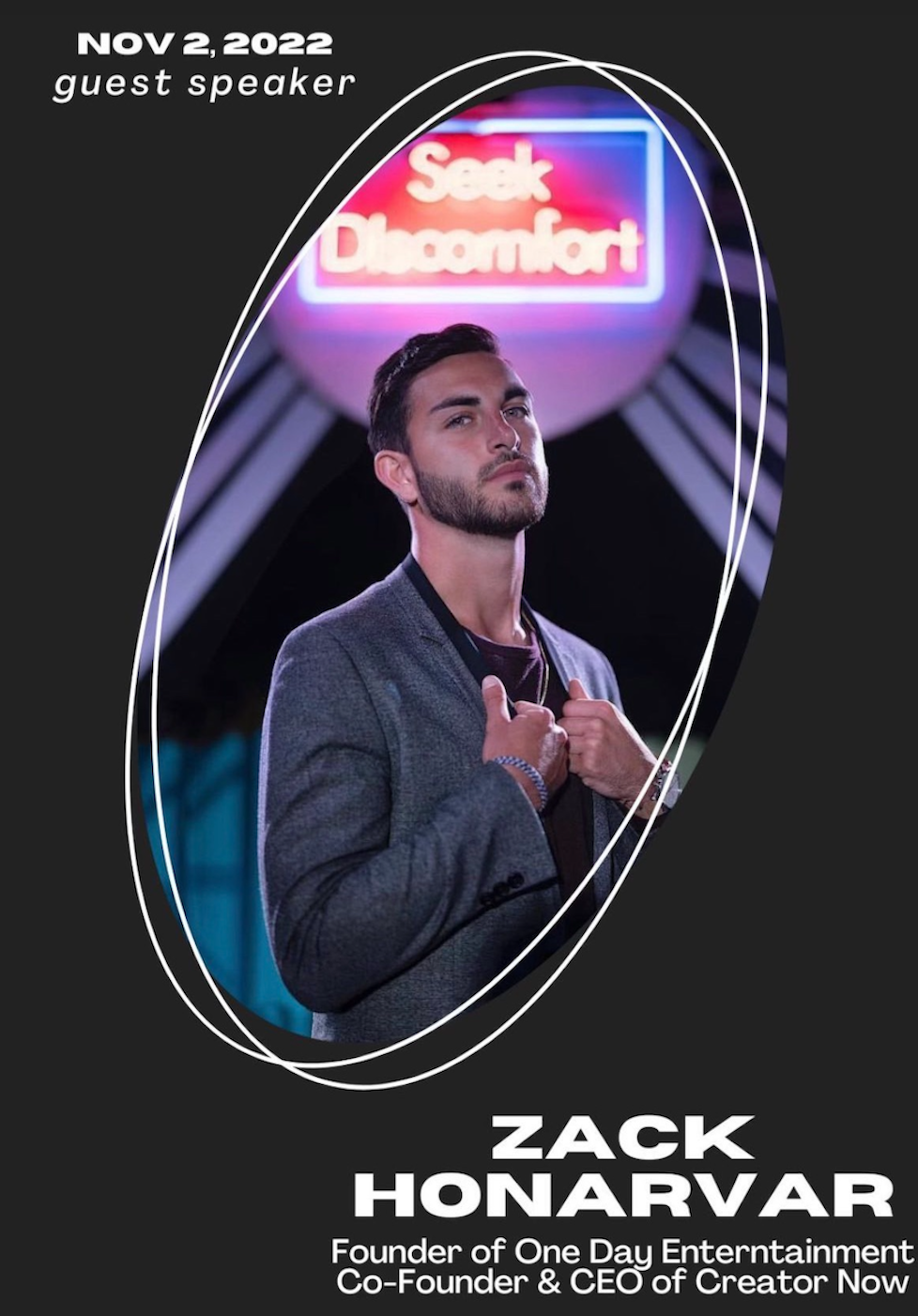
Caption: A flyer advertising the talk to my club's members.
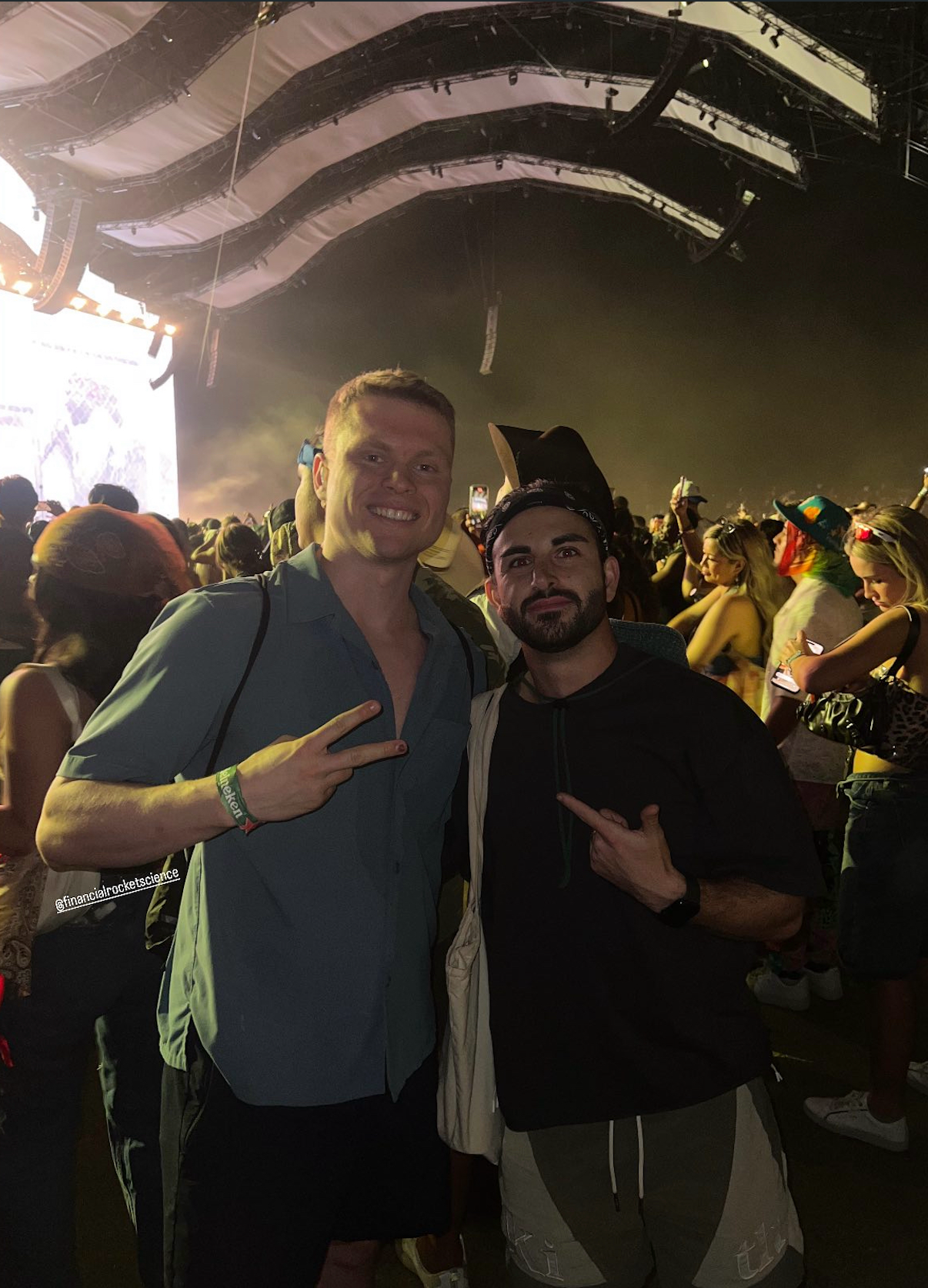
Caption: Zack and I when we ran into each other at Coachella 2025 2-1/2 years after his Fall 2022 USC Talk
Not only is Zack the (now former) Manager of Airrack and Yes Theory, but he's also the Founder of One Day Entertainment, and Co-Founder and CEO of Creator Now, which was acquired for 8-figured by VidIQ in early 2024.
Zack is a serial entrepreneur who's created several successful companies helping creators, and hes someone who might not be well known outside of creator econcomy circles since he works largely behind the scenes, but he's someone that anyone who wants to get involved in the creator economy should follow. In my opionion, he's one of the bets thought leaders in the creator economy, and I'm very lucky to have had the opportunity to meet him through his USC talk in 2022.
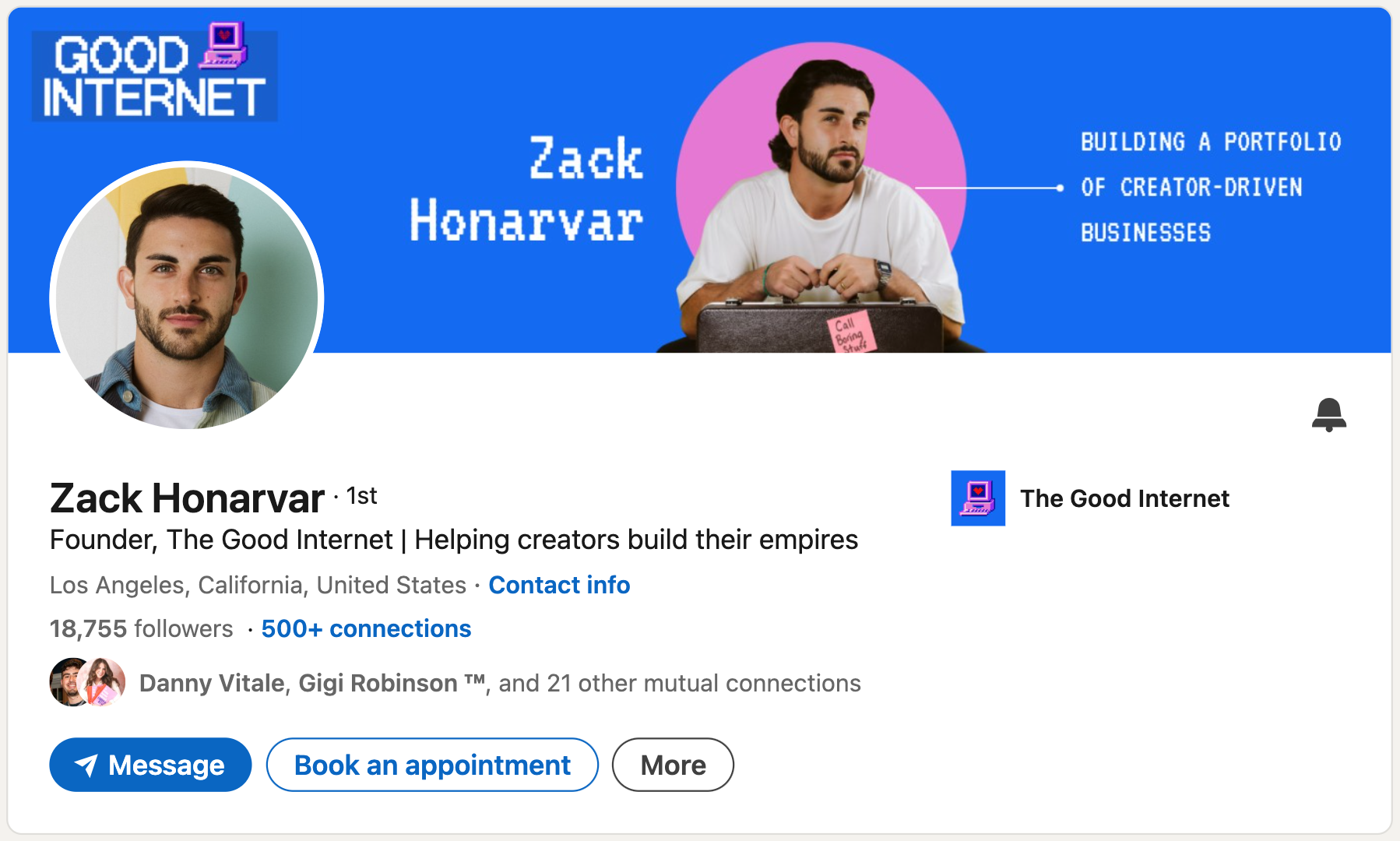
Since his 2022 Talk, he's moved onto creating and managing a portfolio of 7+ Figure Companies in the creator economy, and to better explain what he does, I'll include his latest LinkedIn Bio (as of January 2026) below.
Zack's LinkedIn Bio

Intro & Zack's Background/Story
Going through the detailed notes I wrote down during the talk, the first or one of the first things Zack went over was his value add for us specifically.
He mentioned that he might not be able to give us ALL of the answers in this one talk, but that he might be able to help us through "connecting some dots" which we weren't able to connect before since he has unique perspectives on the creator economy - especially the backend - which most people don't.
By the time he gave his talk at USC, Zack had been in LA for 4-1/2 years.
Before that though, when he graduated college, he had A TON of student debt so he took the highest paying job, which in his view was a BIG mistake!
He hated his finance job that he got and eventually quit - he even tried doing side hustles and other stuff during the evenings so that he could eventually transition into something different.
He mentioned that he SUCKED at entrepreneurship/business in general and lacked the skills back then, so he set out to improve those skillsets since he wanted to be ready when he had his billion-dollar idea.
The first and most important skill in business/entrepreneurship, he determined, was sales, so the biggest thing he did was improving his sales skills.
A year after quitting, he then got an opportunity to work for Shopify, where he worked as an enterprise sales rep and also travelled a lot (i.e. he went to major industry events such as major industry events such as MAGIC, Agenda, ComplexCon, and VidCon).
"How to hack the corporate world and become an entrepreneur"
He talks ALL about all of this - and how to use the corporate world as a lunchpad for entrepreneurship - in his YouTube Talk "How to hack the corporate world to become an entrepreneur" which he said to watch and which I've linked below:
In the video, the 2018 version of Zack gives A LOT of really good advice. As I was writing this article summarizing his 2022 talk at USC, I actually took a few hours to watch and write notes about what Zack said in his 2018 talk which I thought were very useful.
So I'll summarize the notes from his 2018 talk in this subsection (and honestly, they might be even longer than my notes I took in person from his 2022 USC talk). Something he does emphsize though is peer-to-peer mentorship rather than learning from someone wayy ahead of you, so listening to his 2018 advice should make this article even more impactful if you're starting out.
The first thing he mentioned was how he HATED his finance job at Sun Life Financial, since he was literally just sitting in a cubicle all day, and he didn't talk to anyone except for his immediate boss or supervisor the entire time he was there (6 months), and he only punched numbers into spreadsheets and so on and so forth the entire time he was there.
He dedicated his evenings - his "6-10's" - to wanting to become an entrepreneur after his 9-5, but he quickly realized that real entrepreneurs were working from 8am-8pm, so since they were both able to exclusively dedicate themselves to it and because they had way more hours in the day, they were able to simply outcompete him by far.
On a personal note, this sort of ties back into Steven He's talk about being obsessed and his Kobe analogy specifically, where he talked about the number of hours you put in and how at some point it will be impossible for others to catch up - if you haven't read that yet, definitely go back to my Steven He USC talk article.
So going forward, Zack had to figure out how to hack his corporate career to eventually (and systematically) become an entrepreneur.
There's three main topics within the talk which he went over which show you how:
1) Goal Setting:
He believes that writing down goals makes them much more real to you.
But it's not enough to simply "dream big" or to have goals.
He said that you must "Dream Macro, but Work Micro" which means that yes, have your overarching goals, but you must work on the MICRO HABITS every day that will actually get you there.
Figure out what these "small things" are, and put them in your calendar even.
Micro actions and your day to day result in what you'll eventually become and if you will eventually accomplish your macro goals.
Something else he recommended doing regarding goals and goal setting is to write a (future) reflection statement about what it will feel like when you've accomplished your goal - i.e. if you set new years goals on Jan 1st, 2018, then write your reflection statements about what it "felt like" to accomplish that goal as if you were already writing it on Dec 31st, 2018.
2) Networking:
Most people do networking WRONG, according to Zack.
He said that it's GOOD to know people in different industries since you yourself can then bring a different perspective and be a dot connector for them.
Another big takeaway he mentioned is the "myth of old mentors" which is that you usually DON'T want the old rich CEO guy to be your mentor most of the time.
The reason is that you shouldn't look above for mentorship as much because these people are often 1) busy, and 2) don't care about you most of the time.
Instead, he said, look around for peers or look for mentors who aren't too far ahead of you.
If there's too many degrees of seperation between you and someone's advice, then their advice is too early for you.
He mentioned that everyone, individually, is like a business themselves in a way, and that we all should have a board of directors.
He asked: "if you had five friends to make a big life decision, then who are the five friends you'd ask?"
He also mentioned that you should have them all do something called the Meyers-Brigg test for yourself and you "board of directors" so that you know whay each others' strengths and weaknesses are so that you can balance them.
3) Learning to SELL, AND finding out outward-facing job, not an inward-facing one
Two of the biggest takeaways from the talk, especially as it pertains to stretegically working your way into entrepreneurship, is to learn to sell, and to get into an "outward-facing" job, not an "inward-facing" one.
For example, when he was at Sunlife Financial in that dead end finance job, he only saw the same two people every day - his supervisor and his boss. He just sat in his cubicle.
The above example is an "inward facing" or closed off type of job - usually not great, even if the pay is substantially higher, as we saw in Zack's case with Sunlife.
Instead, he said that you should seek opportunities at a company that helps you meet people who you can then build a network from and leverage once you leave the firm - and in his case, he figured that sales would be a great way to do it.
In Zack's case, he went on to Enterprise Sales at Shopify, and he was able to meet people and build relationships with them, and since he treated them well and catered to his needs when he was in his Shopify role, he was then able to call in on them and say "hey man, in my side business (which eventually became his agency), I need some help in X, Y, or Z..."
These people then became his network for when he launched his own talent agency in 2018 which he had recently launched shortly before this talk as he was about to move to LA.
On a personal note, this story / stretegy of putting yourself in "outward facing jobs" also reminds me quite a bit of Sam Freeman's story of how he built his nework with influencers which eventually led to him starting his 7-Figure business, Flair, at 21 years old.
In his talk, Sam Freeman mentioned how he was a nightclub promoter at exclusive West Hollywood and LA nightclubs, which put him in positions to meet people (Addison Rae, her business partners, other top people in the creator economy etc.) and then leverage that to get his next opportunity then eventually build a network of his own which he used to start his company when the time came.
So, the advice to put yourself in "outward facing jobs," whether it's as simple as being a west hollywood nightclub promoter at 21 years old with no connections, or going to work for Shopify to work with creators at at 23 years old, is advice that Ive noticed is a common thread across both Zack's and Sam's stories over my last two articles.
Zack also reframed sales in a VERY USEFUL way for everyone in the 2018 talk as well.
He defined sales as "Sales is not about selling people stuff that they don't want to get and being sleazy about it... Instead, sales is totally different... It's about finding people who want to buy your product, and then helping they buy it as easuly as you can."
Sales is GREAT training for entepreneurship as well, in the sense that you'll get a lot of no's, but it's actually in fact a very normal thing in entrepreneurship.
90% of the time in sales, you'll be told no, and in entrepreneurship, you'll be told no "99.99%" of the time, but what's important is the few times that you'll get told yes.
For example, when he started his talent agency shortly before his talk, he went to LA for a long trip, called a bunch of creators, and asked them if they wanted to be managed by him, e.g. he called up Logan Paul and Jake Paul and asked them if they wanted to be managed by him, they said no, BUT Jake Paul did tell him that he has some friends who needed management, and to talk to them, and eventually that for example led to some yeses.
That's a great example of how sales (and entrepreneurship) works. He essentially said that the way sales generically works is similar: you call up 100 people, and if you're selling a pen for example, you ask "Do you want to buy a pen?", then he'll get a lot of rejections and a lot of no's, then EVENTUALLY, someone says "Yes, I think so" or "Yes, I want it" then Zack proceeds to ASK for a REASON (if he gets a yes or a kind of yes), then his job is to make that reason big, which will then lead the lead to the "holy grail of a pen" to solve their problem.
"That, my friend, is sales!"
Other Misc Advice From The Talk
After his main three points from his 2018 talk lined above, he mentioned that University for him, was NOT about the piece of paper (e.g. his trandcript or the classes he took) AT ALL. He didn't care about what he learned in school, but instead thinks it was worth it instead because of what he learned from the people around him, and from what he learned by attending events like this. Those latter two things were 100% of what he took from his university experience.
One of the questions during the Q&A was about how he got into goal setting, and a book he recommended on this topic was Good to Great by Jim Collins which essentially mentioned that becoming good is actually relatively easy, but that becoming truly great is HARD.
Zack essentially asked himself "am I doing what everyone else is doing?" or "am I actually doing what I need to do in order to become great?"
Another question that was asked of him was "when did you realize or figure out that you wanted to be an entrepreneur?"
He said that in his first year of university, he wanted to become an investment banker, make a lot of money, and wear a suit and tie everyday. Over time, he realized he didn't want to do that, and his thinking evolved over time.
He said that there wasn't really one moment where it happened or where he realized it on one moment.
He was just always testing.
And he mentioned that you have to be honest and vulnerable enough with yourself to realize when something's not working or what you want anymore, and not to get sucked any further into it.
He said that you have to be ok with going into something not knowing whether it's going to be your big idea or whether it will fail.
The main solution though - even though there is no surefire answer - is just to keep doing new things, and to constantly be asking yourself what the best thing you can be doing at the moment is.
A big problem that he saw with a lot of people from his university for example is that a lot of them just stuck with the thing they though they wanted to do their first year (e.g. accounting or investment banking) but they they just stayed with it because they didn't want to to admit that they made a mistake and were wrong.
He said that this is what happens when they wake up one day and realize that they never did this goal setting. That just stay stuck - not even in a 9-5 - but in a 10am-12am investment banking job and only then realize it's not what they bargained for.
For me, I've personally seen a similar pattern in my life as I've asked people older than me for advice as well. As my entrepreneur brother pointed out, most people (unless if they catastrophically screwed up their life) generally have a confirmation bias for the path they took - so if they got a master's degree but not a PhD or if they dropped out of their PhD, they will tend to favor that. If they finished the PhD (oftentimes, even if it took 8 years!) they will still defend that decision, even if from an outsiders perspective it doesn't always seem wise in their specific circumstance.
Zack mentioned that you should always do what you think is best at any particular time in your life, BUT don't be afraid to pivot or make a change later if you figure out it's not working.
Something he's realized, in his opionion too, is that taking a leap is actually not that hard - even though people will probably be confused or laugh at you when you initially do (hint: Harry Gestetner contrarian lesson from the FanFix article).
He said that the main takeaways in his answer to thie question are: always be willing to change, be true to yourself at that moment, and don't take yourself too seriously - in the sense that you always have the option to change and say "oh! I was wrong! Accounting is actually boring, Who Knew! for example.
In Zack's Opinion, don't do something NOW that you don't like in the hopes that one day it will get you to something within that sector that you do like.
Obviously you can either take or leave the advice, but he thinks that after a certain point, once all of your basic needs and financial stability criteria are met (e.g. 70k a year in 2018 Canadian dollars), money doesn't determine happiness, but rather, he thinks it's all about what you do (and who you're around), and whether you have fun with it.
He thinks that money and happiness are usually a byproduct of doing something that you like. I have some qualms with this specific point, but I do agree with NOT being in something you hate.
For me myself for example - did I enjoy every painstaking minute of my Bachelors degree in Aerospace Engineering, where I started at 16 years old, as much as say I enjoy watching the Minnesota Vikings or LA Lakers or Dodgers play every year? No!
But that aerospace degree allowed me to earn a full ride to my MS and PhD at USC, which then allowed me to both move to Los Angeles and also coincidentally join the social media club there and network with big creators and leading individuals in the creator economy (like Zack) eventually.
This is a living blog, so I guess that I'm still in the middle of that journey myself. I definitely wouldn't have gotten to be in the position I was in at USC without doing something I "didn't like (as much)" as becoming s ay a YouTuber first, although maybe I personally am following Zack's advice of "don't be afraid to pivot" and admit that you're wrong, at least in the sense of re-evaluating whether attempting to finishing the PhD at USC is the best career decision for me at this point compared to diving in industry and going all in on content.
One last thing that Zack left the audience with in this lecture was his view that your mindset should be that university and your 20s shouldn't be the best years of your life. In your 20s especially, but also throughout your life, you should be using those prime years to DEVELOP yourself into the person that you want to be, instead of either YOLO'ing or being stuck in a dead end / non-exciting career.
He said that while you shouldn't completely discard your 20s, your mindset should be that NEXT YEAR should always be the best year of your life.
In a way, it sort of reminds me of Tom Brady saying that his favorite super bowl ring is "the NEXT one" every time someone asks which of the seven rings is his favorite.
Back To Our Talk With Zack
Find "Outward Facing" Jobs
I already mentioned this in the above summary of Zack's 2018 talk, but I'll repeat everything he also said in his 2022 talk here which I took notes on.
He specifically said that one of the big takeaways from the 2018 talk about hacking your corporate job to become an entrepreneur - a talk he highly recommended to listen to by the way (which I didn't until now, 3-1/2 years later, as I looked at my old notes and put together this article) - was that you should find a job that will put you "outward facing" and then you'll be able to get a ton of other opportunities because of that.
When you have a job like that, you'll make connections that will serve you going forward, especially since that way, "people can see how dope you are."
He primarily grew his network through his job at Shopify by going to meetings and trade shows (such as the ones I mentioned before like MAGIC, Agenda, ComplexCon, and VidCon, etc.), and his network grew A TON from that.
Eventually, he ended up in LA in March 2018, and met Yes Theory, who were young YouTubers with only 100k subscribers at the time, then since he had experience at shopify before, he looked at merchandising contracts for them and helped then create a merch line.
He became their manager, and that led to Zack's career that he has today of first managing some of YouTube's biggest creators, then making businesses that help creators build empires.
Figure Out How To Help Creators Make Money In A Way They Currently Aren't
One of the biggest lessons Zack extracted from this is that if you want to collaborate or do business with a creator, you should have expertise in a world that the creator or business doesn't have (and figure out how that specific world works), and help them make money (with that, usually) in a way they aren't already making money.
This strategy is one of the best ways to work with creators, Zack said. Bring value and help they make money in a way they already don't.
Once he did this with Yes Theory, a ton of other creators came up to him about starting a merchandising business. He saw that creators had the opportunity to create businesses outside of their channels, and thus this set him on the path to where he is today where he helps creators build sustainable businesses ("empires") to help them diversify outside of content.
He started his management company (One Day Entertainment) shortly after he moved to LA, but started these other ventures which led to multiple 7-figure exits and ventures in the years ahead (such as Creator Now and his portfolio of The Good Internet companies).
Treat Your Creator Career like You're an NFL Player
When I first started as a personal finance and money content creator, I was lucky to get the chance to hang out with a lot of the other top short-form personal finance creators, and a mindset that all of them always had was that "[for most of us,] being a creator is like being an NFL player... you make A LOT of money for maybe 2, 3, 4 years, then BAM, your career is over... and you have to then parlay that money into starting something more sustrsinable long-term like a business."
Zack said something very similar, which is that he looks at creators as NFL players, where you're "only one ankle roll away" from your career ending, brand deals drying up, etc., so having these other more sustainable "forever" businesses set up is huge.
While I don't have it written in my notes from the talk, a statistic that I remember from the talk that stuck with me that also ties into the above point is that Zack said that "the average lifespan of a creator is 26 months..." (as of late 2022) which is definitely an alarming statistic and only further underscores the point of it being similar to a pro athlete's career and the need to create spinoff businesses from that.
Creators Are Becoming Full-Blown Companies
Similar to what Steven He said in his 2025 talk at USC three years later, creators are becoming corporation in and of themselves. The standard is definitely much higher than 10-15+ years ago when you could easily go viral from filming in your bedroom.
Zack specifically said that creators are essentially becoming production companies and media entities. They're hiring their own producers, editors, even ideation strategists, business development people, operations, human (resource?) development teams, and so on. Instead of just having a manager, creators are hiring specific people on their team to do what a manager (or they themselves) used to do instead.
Notable Traits and Qualities That He's Seen in Big Creators
Zack also went on to talk about qualities and traits that he's seen with the big creators he works with.
Harkening back to Steven He's talk which I already wrote an article about, Steven mentioned that obsession is the one universal trait that he's seen with 100% accuracy across all hyper-successful people who he's met, regardless of industry.
With creators specifically (who he puts in the same "talent" bucket like artists, musicians, and other entertainment people), Zack thinks that there's three primary qualities that have taken the far in their careers:
1) A healthy degree of Narcissism. Zack thinks that a higher or healthy degree of narcissism is very common amongst top creators and talent in general. If you have this as a trait, you'll be able to ask for more in life as a result and also act like you belong there. The most successful the creator is, the more narcissism they tend to have, in his opinion.
2) Impulse Control is another common trait, especially as they get bigger. They don't take nights off randomlyy, especially as they get bigger.
"They are willing to give up a good time today for a great time tomorrow."
3) A lot of them are self-critical and they always think of a million things they could've done better. They also don't celebrate a ton all of the time.
Zack thinks that the speech that drake gave when he won artist of the decade is a GREAT example of this:
Finding a Manager + Doing Outboung Brand Deals
After the talk, I went up to Zack and apparently asked a question about when you should find a manager and/or do outbound brand deals (according to my notes).
Zack mentioned that if you're on youtube, wait until about ~50k subs to do outbound, or ~1M or so followers on TikTok to start doing outbound brand deals.
The main thing is to just grow a ton and then the brands will come to you.
Outbound doesn't matter until that starts happening.
As far as finding a manager, he's wait until like 5M+ on TikTok, only when you get to the point where things become extremely unmanageable and events and deals etc. become so large that all of the terms of service and such need to be carefully looked through.
That way, you'll also learn all of the skills yourself, which can be helpful for a variety of reasons.
In the meantime, you could try a "fake virtual asisstant" where you make an email that isn't your name, but it's still you doing the brand deals, but it's not necessary.
He mentioned how even Graham Stephan still negotiates most of his own brand deals as an example despite how big he is. As a result, he gets ot keep all the cuts and have no one else take a slide of the pie with his brand deal revenue.
Contact Zack
Zack gave us his email after (which I won't give here) if we had any questions, but I'm highlighting it here since he said that he gets A LOT of email and often has to ignore spam.
But if any of us wanted a guaranteed response, we had to make "Purple Monkey Dishwasher" the email subject line in order to guarantee a response.